Saturday, July 19, 2008

Comics, comics, everywhere...

with esteem and respect to Bruce Eric Kaplan

I have cited this cartoon before, because I think it sums up the mainstreaming of comics that we seem to have been experiencing over the past few years. We can parse out the details, but there's no denying that folks are talking about comics out in the open, without apology, with more frequency than ever before. This situation was driven home to me over the past few days.

First off, I got a phone message from a pal telling me that a local AM talkradio host was going to be interviewing Neal Adams. I tuned in and for a solid hour Adams talked about the reinvention of Batman in the sixties after the television show and other topics that wouldn't have been out of place on any comics blog. Check it out: July 15, 2:00pm.

I grant that that interview might have been sold because of the Dark Knight movie, and that the situation in general has been helped by so many comic book adaptations or comics-inspired films being released this summer, but c'mon: who would have imagined that a regular essayist on NPR would contribute a piece examining in detail the DC fan/Marvel fan divide, under any circumstances? Yet this is what I heard the very next day on Morning Edition, in a piece by John Ridley.

The next day, Steve Scher, the host of Weekday, a local program on the Seattle NPR affiliate, devoted a whole hour of his show to comic books, speaking with Mike Mignola and Douglas Wolk, among others. I guess this shouldn't have surprised me so much, since Scher spent a whole hour interviewing David Hajdu a few months ago, when Ten-Cent Plague came out, and constantly surprised the author with his depth of understanding of the subject.

Out of curiosity, I did a search on the NPR site tonight, and found that this afternoon I missed an All Things Considered report on international comics and that a few days ago Day to Day used the Batman movie opening as a springboard to do a fairly thorough examination of the evolution of The Joker over the years. That's all in addition to pieces on Dark Knight itself.

To top it off, I stopped by the library this week to talk to another pal, and she gave me a copy of the SPL annual report: they got Ellen Forney to produce it in "graphic novel" format, which is to say it uses some specific elements and the general aesthetic of comics to present the material. Here's the cover and a sample page:


So, while I don't think that we'll be seeing folks on the beach reading comics a regularly as paperbacks, or that graphic novels will replace newspapers as the commuter's reading material of choice, it seems pretty clear that the door to the general culture is opening wider and a little bit of light is being shed onto the shadowy world of comics geekdom.

Tuesday, July 08, 2008

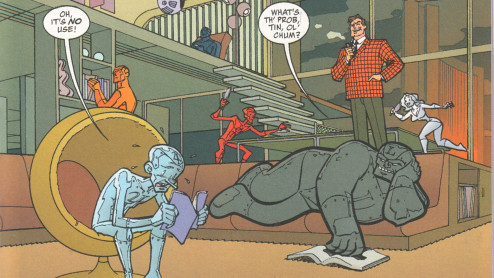
Zip! Bang! Zot! It's The Librarians!

One of the old TPBs in the Last Shortbox is Zot! Book One (Eclipse Books:1990), which collects the first half of the original ten-issue color run of Zot!, Scott McCloud's whimsical-yet-thoughtful take on the Flash Gordon style of adventure story. I have always liked this series, mostly for its mischievous tone, as it apparently alternates between parody and hommage of its source material. McCloud's talent is clearly in its developmental stage here: the illustrations are as masterfully expressive as any of his art, but he doesn't seem to display the same easy command of line and form as in his later work, and the plot can be pretty pedestrian. It's well worth a read, however, and not just for its historical value.


I recently acquired another Zot! collection:


Zot!
The Complete Black and White Collection: 1987-1991
By

Sunday, June 29, 2008

Another excursion into definition

Take a look at this little prose piece:

The proud Kuleeah was furious because Tarzan had made sport of her. Now she dashed toward him, determined to redeem her pride with his blood. She aimed a murderous blow at the head of unarmed ape-man. Again, Tarzan dodged, whirled, seized her, and lifted her high above his head. There he held her, kicking and squirming, while her comrades hurled gleeful taunts.

Though they laughed at Kuleeah's plight, they were impressed by the mighty Tarzan. “He can be my husband, though he conquer me and rule my hut,” cried one. This was heresy among the Amazons, who prided themselves on their dominance over men.


“I'll take him,” shouted another.

“No, he's mine,” insisted a third.

Soon, the tribe was in turmoil. As the warrior women fought amongst themselves, Tarzan set Kuleeah down. She ran away to get her bow and arrows. If she could not have him, no other would.

Then, suddenly, into this wild confusion burst a pack of hungry lions.

Although it does start in media res, this passage appears to be a pretty complete section of a narrative. Even from this excerpt, we can discern a lot about the characters and setting, and we can certainly follow the action. Is this a bit of a Burroughs book, or some fanfic, or what? Well, take a look at it in its original:

Click to embiggify

I ran across this Sunday strip at the ASIFA-Hollywood Animation Archive, which also has a wealth of comics and cartooning stuff.

I forget why I stumbled over it, but looking at this page immediately got me to thinking: there is no one, I think, who would exclude this page from a collection of comics, or comic strips, or sequential art, or graphic literature, or whatever phrase we want to use for all that funnybook stuff we like so much.

And yet, if we really look at the strip, there's no real fusion of word and image to make meaning or create communication. The text, as demonstrated above, can easily stand on its own and carry the entire narrative weight of the piece. The art, as exquisite as it is, really doesn't help to tell the story; it contains nothing new, no information that isn't already expressed by the text. The drawings certainly couldn't stand on their own and give us anywhere near the narrative detail that the text does. (For example, is there anything in panel four to indicate that the Amazons are "hurling gleeful taunts"?) To paraphrase Steve Lieber, the pictures may illustrate the story, but they aren't the story.

This seems to contradict what we expect from comics, that magical conjunction of words and pictures that creates something new, something that is neither merely prose nor art, but, well, comics.

We mist be missing something, but damned if I know what it is.

Maybe definition isn't that important after all.


This makes a dozen dozen posts on this blog: 144 entries in 915 days, about one a week. I know, that's pretty gross. I was looking for a significant milestone to quit on, and I thought this might be the one. But I don't think so now; there may be a few more things I want to say before that.