Wednesday, January 11, 2006

Team-up Time

DC Comics Presents was a great book with a crappy title. Published from 1978 to 1986, this was Superman's version of Batman's Brave & Bold: each month, Superman would team up with a different hero. The series began with a classic trope, a Flash-Superman race. As the series progressed, sometimes the guest would be an established star, sometimes a supporting character being revived, sometimes a new character being promoted. There was great story arc in the late 20s - early 30s numbers (with Green Lantern, Supergirl, Martian Manhunter, and my second-favorite Starman) that introduced Mongul (and not incidentally included an insert for the premiere of the New Teen Titans).

I had all that stuff, almost a complete run, and when I sold them, this is the sole issue of DCCP that I kept:
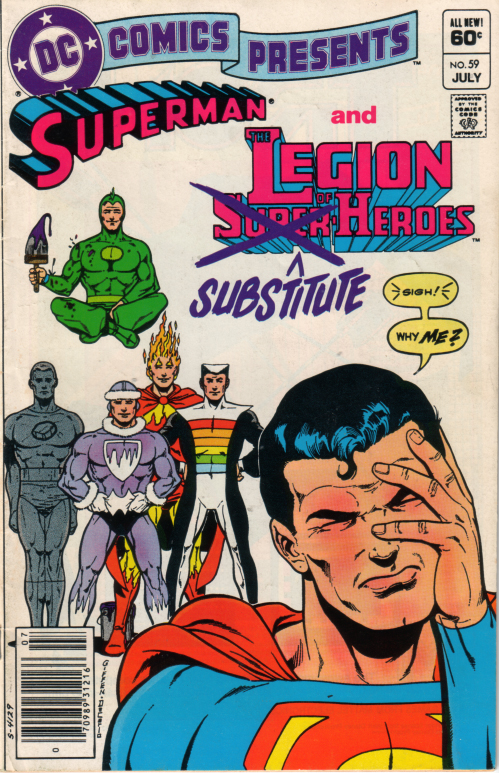

DCCP 59, July 1983. "Ambush Bug II" Story and breakdowns: Keith Giffen; Additional Dialogue: Paul Levitz; Finishes: Kurt Schaffenberger.

The plot of this issue is simple: Ambush Bug hitchhikes a ride with a time-traveling Superman and causes chaos in the 30th century (the era of the Legion of Super-Heroes) until he can be corralled again. It's all just a simple framework on which to hang a great deal of fun.

First of all, Giffen's layouts are dynamic and energetic throughout; even the pauses in action (not that there are many) seem relatively frenetic.

Schaffenberger is a wonderful match for art duty here. This Golden- and Silver-Age great, perhaps best known for Lois Lane, is not just a token link to the grand tradition of comic illustration; his command of the subtleties of facial expression and body language make the story click.

Plus, he makes Superman look like he just stepped out of a Fleischer cartoon!


The earnest and helpful young man with Superman is Polar Boy, the leader of the Legion of Substitute Heroes, comprised of rejected LSH applicants. These losers were a wonderful secondary story in the world of the LSH for as long as I can remember, and they fit wonderfully with the mood of an Ambush Bug story. I have always had a soft spot for these guys, and apparently so has Giffen: the story is means to parade them all across the page, from Porcupine Pete and Infectious Lass to Color Kid and Antennae Lad, as well as the aforementioned Polar Boy (who actually spends most of the story unconscious). Ambush Bug is such a menace that the Subs even call in their Auxiliary! In the words of Science Police Chief Zendak, "Lord give me strength."
(BTW, I never understood why Polar Boy never made it into the LSH. Most of the other rejects had unworkable flaws in their powers; for example, Stone Boy could turn to stone, but he couldn't move while rocky. PB has typical "cold guy" powers and I can't recall a problem with them. It must have been politics.)

Ambush Bug himself is clearly in early days here; this is only his second appearance ever in the DCU, and it shows. While there is a Bugs Bunny-ish timbre to his mischief, he functions more-or-less as a traditional foe, in the troublemaker club rather than the evil nemesis club. He still needs little flying robotic bugs to facilitate his teleportation, there's no breaking of the fourth wall, and he often acts a lot like a typical supervillian,


only funnier:


(That's a piece of Superman's wedding cake, I think; Ambush Bug was ransacking the 30th century Superman Museum, so I can't imagine what else it might be. Oh, and he's wearing Superman's cape -- he stole it earlier. You get the picture.)

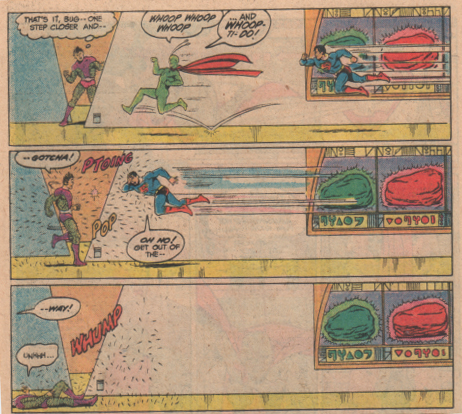
I like this Ambush Bug. The later version was great for self-conscious meta-commentary on comics and for obvious satire, but early on, he could fit quite well with the internal consistency of the DCU and still be the springboard for superhero comedy:


When I get tired of all the hubbub about darkness and meanness in comics (and it's not all peaches and cream in the short box), this comic is a great big glass of organic ginger ale: crisp, bubbly, and well-made.
Friday, January 06, 2006

It's still Friday...

.. and I'm here, after a fashion. The regular Friday update will be a little delayed. I just wanted to say thanks to Ragnell and Scipio and Amy & Franny for the links (you can find them in the sidebar as Written World, Absorbascon, and So So Silver Age, respectively). More to come soon!

Wednesday, January 04, 2006

The Saga of Liza Warner

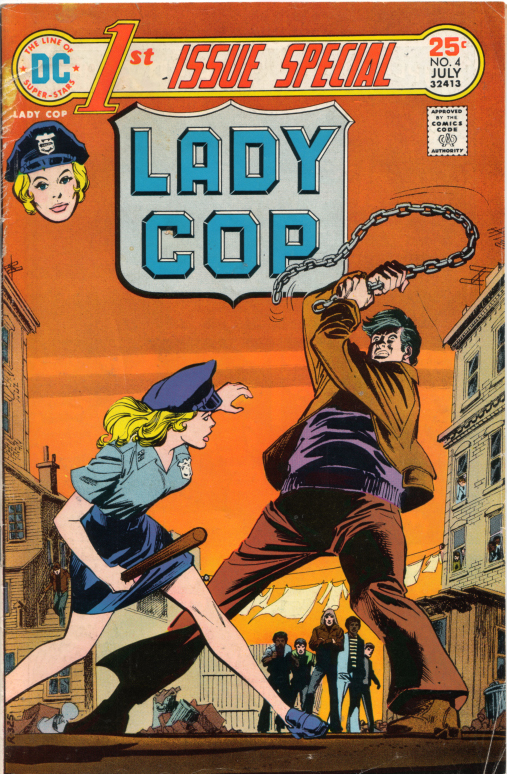
In September of 1974, Police Woman debuted on television. This spin-off of Joe Wambaugh's fact-based Police Story series starred Angie Dickinson as Sgt. Pepper Anderson, an undercover officer for the LAPD. Shortly thereafter, in the July, 1975 issue of 1st Issue Special (a Showcase-like tryout title), DC Comics introduced their own female law enforcement agent: Liza Warner, Lady Cop!


Story by Robert Kanigher, Art by John Rosenberger and Vince Colletta

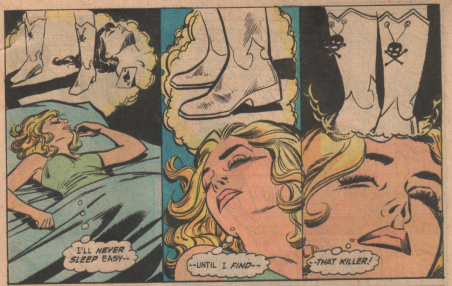
Liza has a fairly typical "origin" story. She witnesses the murder of her two roommates by a serial killer who leaves playing cards (the ace of spades) at the murder scene; although she could only see his death's head cowboy boots, she vows to find him.


Unlike what most other comics characters in a similar situation would do, Liza does not hone her body to physical perfection, don a colorful costume, and become a vigilante. No, she just joins the police academy, as a relatively sane but somewhat committed (or even driven) person might actually do.

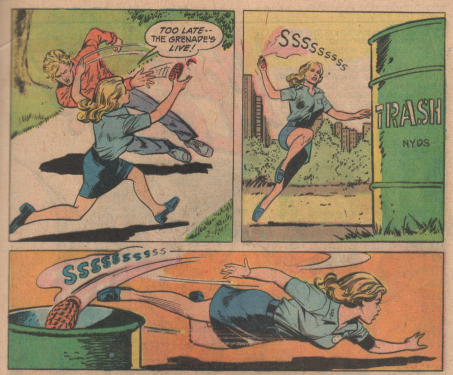
In the academy, she is taught firearms skills and hand-to-hand techniques comprising "three karate kicks -- three judo throws -- the wrestling tactic of "bridging" -- boxing -- [and] defensive blocking." (I don't know why the martial arts curriculum is so limited; maybe this was a low-budget academy.) Liza proves her mettle at the graduation ceremony when she stops a disgruntled flunkee from distrupting the ceremony with a grenade.


With congratulations from the chief, Liza's five-page origin story is over - now Officer Warner can shine in her own 15-page saga!

Warner walks a beat in a tough inner-city neighborhood (where else?). In short order, she rescues a young girl (who quickly disappears) from manhandling by a local thug and his main goon (taking the latter out with a serious head-butt); buys an ice cream cone for a poor child; stops a knife-wielding robber with her hat; and gives mouth-to-mouth resuscitation to the robber's victim, a grocery store clerk. All on her first shift.

Y'know, I was a cop for almost six years and I never did any of those things. But then, I didn't walk a beat in a tough inner-city neighborhood.


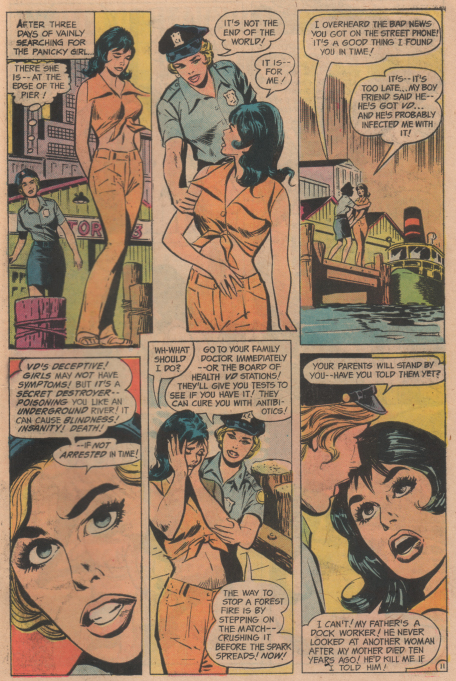
After a break for a beach-date with her honey, Hal ("Here's where the cop becomes a lady!"), Warner is back on the beat, and finally finds her vanished victim. The young girl is has been in hiding because... well, let Lady Cop fill you in:


Yes kids, we used to call it VD, not STD, and while it was still a threat, it could be cured with antibiotics - and its spread could be prevented with sylvan metaphors! Well, while things weren't really all that simple, pre-AIDS sexuality was indeed a different thing than it is today.

Anyway, Warner's PSA sets the girl and her father straight, although Warner does have to take a left hook to the jaw (without flinching) in order to get dad's full attention. And all's well that ends well.

Oh yeah - except that the head-butted goon from the first fight comes back to mess up Warner with a chain. He obviously doesn't know who he's dealing with: she promptly and casually throws him into the harbor, where he would have drowned without her intervention and the timely arrival of a police boat. (If this had become an ongoing series, I would like to have seen that guy return every issue to get his clock cleaned in a different fashion each time. It would have made a great running gag. And then he and Warner could have had a cup of coffee together for the Christmas issue.)

So, the story actually ends with Officer Warner wondering - of course - if she will ever find the killer in the cowboy boots. As far as I know, she never got the chance to look - Lady Cop made no more appearances.

I like this book. While it suffers from all the faults of silver-age writing and has not aged very well, it was obviously an attempt to portray what would have been called at the time "a liberated woman," and is thus redeemed to a degree. Liza Warner gets respect and camaraderie from her fellow officers, without condescension. On their date, Liza is given grief by Hal for being a career woman; in response, she is unapologetic and doesn't give an inch. Liza Warner is tough, smart, and compassionate - as unrealistic and as admirable as any comic book hero ought to be. I wish she had had a longer career - I'll bet she could teach those folks at Gotham P.D. or the Metropolis Special Crime Unit a thing or two.

A few other notes:

Although Liza is seen at the firing range during the academy sequence, she is never shown handling or even carrying a gun after she graduates. I don't know if this was in Bob Kanigher's script or if the artists just left it out.

The city in which Liza lives is never named, but the police uniforms say "NYPD."

Liza is referred to as "chick" seven times in the story.