Friday, January 20, 2006

Extra special

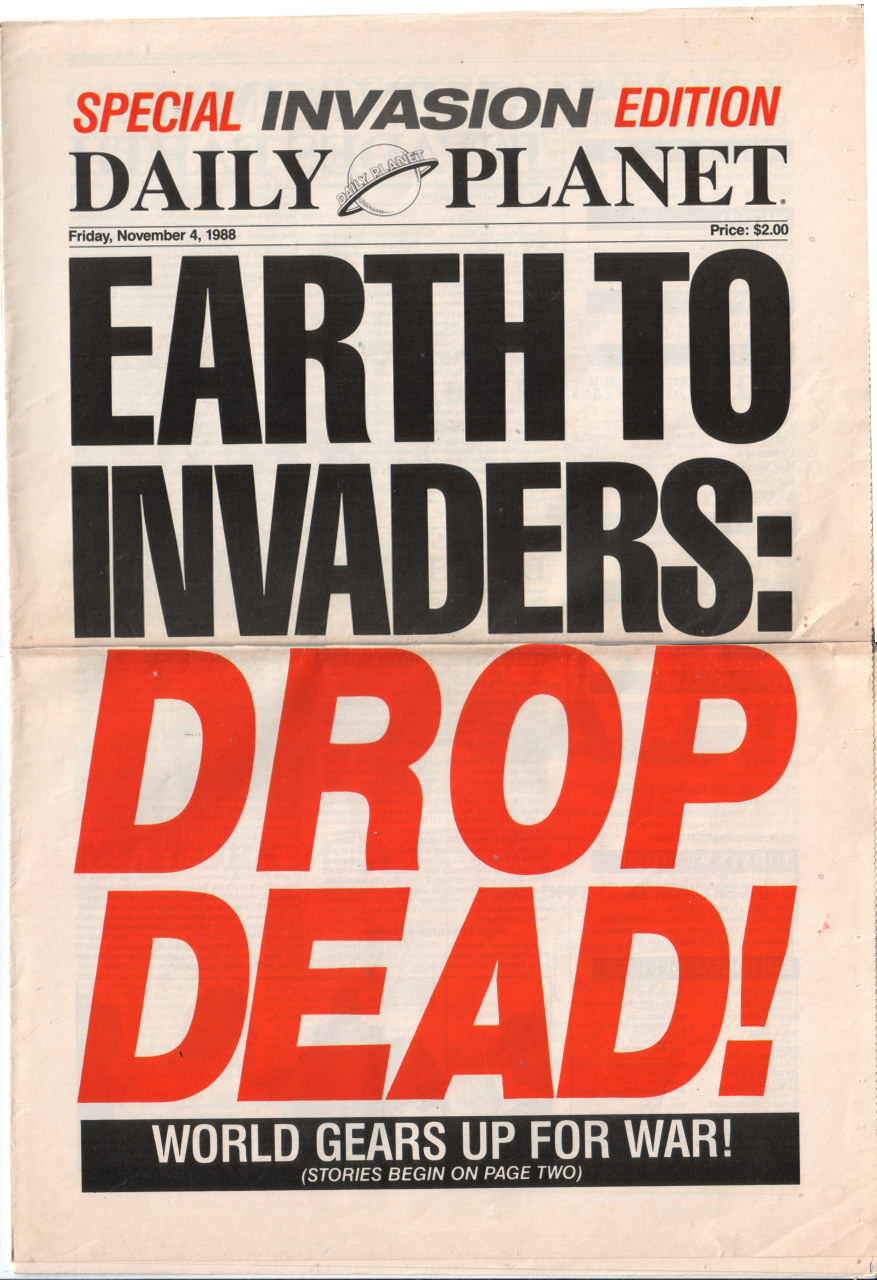
Last episode, we were looking at the Special Invasion Edition of the Daily Planet, and marveling at how well DC had captured the "look-and-feel" of a great metropolitan newspaper in this novelty item.

This time around, I'd like to look a little more closely at some of the contents. In addition to articles that worked to develop in-story continuity for the Invasion saga, the DC staff was obviously having a great time playing with detail.

Let's look at the bylines first. Here are all the names listed as writers of the various articles along with what I think I know about them:

Alfonso McGeahyua (I have no idea who this might be, but it sounds a bit like a Denny O'Neil pseudonym))
Dan Raspler (editor)
R.E. Greenberger (writer)
Kevin Dooley (editor)
Robert Loren Fleming (writer)
Renee' Witterstaetter (editor/colorist/letterer, and the only byline to also be listed in the 'real" credits - as Assistant Editor)
Michael Delepine (letterer?)
Barbara Kesel (writer)
John Mahoney (no idea - Byrne apparently had a character with the same name in Superman at about the same time, but he was an astronaut)
Don Lambert (big-time comic collector)
Perry White
Clark Kent, mild-mannered reporter columnist
Albert DeGuzman (letterer)
Paul Levitz (sometime DC president)
Catherine Grant
Nola Krowdish (the advice columnist, and I guess this was a made-up name)

(Hey, there's no Lois Lane - what's up with that? I can't remember if anything happened to her in the Invasion story.)

Oddly, the three sports reporters are also blanks or near-blanks:

Bud Sheldon
Murphy Breen
Maura Healy (unless this is Alex Ross's lawyer)

Now, I have no idea whether the real folks listed actually wrote the pieces with their names next to them; in some cases it would make sense, but in others it wouldn't necessarily do. And if some of them did write the articles, then where did they pick the names that didn't? There's a story there, and we don't know it...

Here's the masthead for the Daily Planet:


Who the heck are all these folks? My guess is that at least some of them are office types from DC, but I really don't know, except for the nod to E. Nelson Bridwell (which is totally cool).

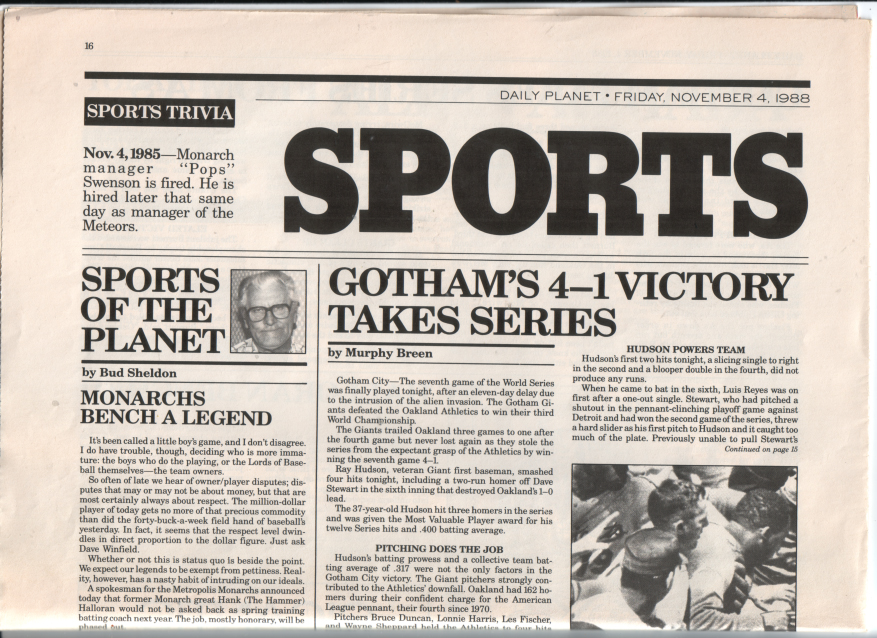
There's a similar mystery with regard to photographs. Take a look at the sports page:


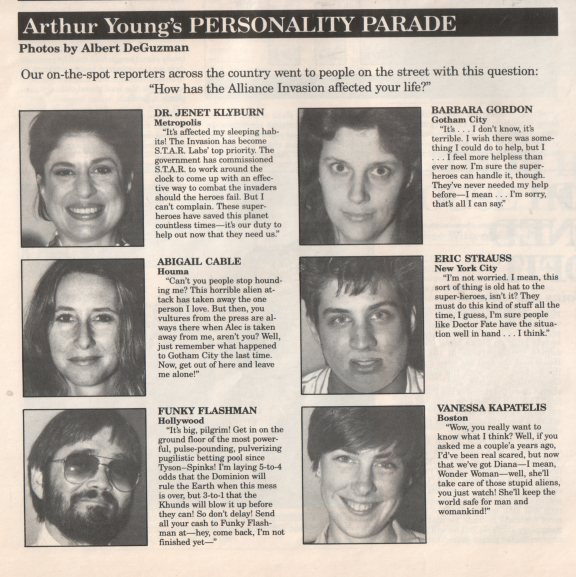
Besides figuring out who "Bud Sheldon" is - whose photo is that on Bud's column? Anyone recognize him? There are photos like this throughout the paper. Try these:


I think that first photo is of Jeannete Kahn, the longtime DC publisher. Anyone recognize any of the others?

The photo feature also highlights another charming characteristic of the work: the integration of minor and supporting DC characters throughout the stories and features. It's a geekish name-dropping heaven. Here's Cat Grant's gossip column:


Johnny Nevada! Roy Raymond! Morgan Edge! Jack Ryder! Steve Lombard! It's DC's version of a Love Boat cast.

Like the news articles, some of the continuity-referential stuff was also pretty straight. Here's Perry White's editorial:


Pretty much an excellent bringing-to-life of what we had long been shown as the Planet's stance on superheroing.

Here's Clark's byline graphic and a bit of his column. Looks and reads smack in character:


A lot of the other non-news stuff was just plain funny. Here's the TV listings:


I think it's cool that in the DCU, Nipsy Russel got a show instead of Bill Cosby. And I think that the RTV lineup is hilarious. (Does anyone else remember when MTV actually played music videos?) I love the combination of DCU characters' shows and parodies of then-current series. Anyone who watched TV in the eighties should get all the references.

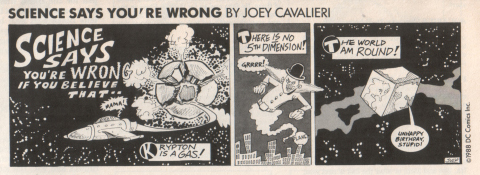
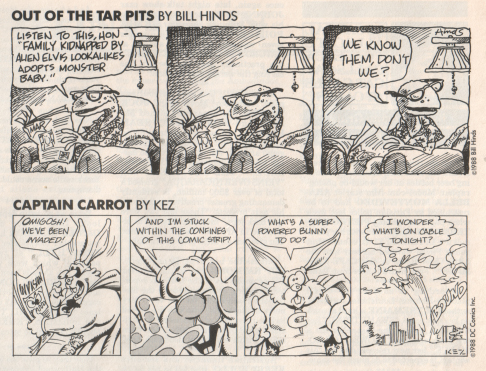
Of course, even in the midst of an alien invasion, newspapers will print comic strips. The ones in the Planet were a great mix. Two were shout-outs to old school DC fillers:


(I loved this feature.)


(Hey, how about a mini-series teaming up Casey with Liza Warner?)

I add these last two because I think the first one is funny regardless of its context, and because the second one is self-referential on so many levels.


There you have it - as far as I know, the only copy of the Metropolis Daily Planet published on Earth-Prime. If you ever have a chance to pick one of these up, do it. It's great fun.

Wednesday, January 18, 2006

Extra! Extra!

Back in 1988, DC had a title-spanning Big Event called Invasion. The main story concerned a bunch of alien races joining together to, uh, invade Earth, partially just to figure out what's up with all these pesky superheroes. (This story either introduced or elaborated on the whole metagene nonsense, but I won't get started on this whole trend of needing find consistent threads in superhero origins - metagenes, mutants, The Green, The Speed Force, whatever.) There were three stand-alone tales (80-pg. Giants!) and, of course, the story crossed over to just about every title for a month or so.

I was more confused than impressed by it all: I wasn't buying a whole lot of titles when it came out and I never did quite get my head around post-Crisis continuity anyway (but then, neither did DC editorial, apparently), so I am sure I didn't understand it as well as I could have. I remember the art being terribly uneven and the story being not much. When the collection went out the door, Invasion went along.

But there was one Invasion-related item that I keep and treasure, and re-read occasionally (although it's not physically in the shortbox):


That's right, a copy of The Daily Planet for November 4, 1988 - the day after the alien races invaded Earth.

This is an actual sixteen-page newspaper: four sheets of 23 x 16 inch paper (a little heavier and slicker than regular newsprint, but not quite magazine stock) folded to make a slightly-bigger-than-tabloid-size (16 x 11.5) paper, with no staples or binding. It was sold folded in half, the way full-size newspapers traditionally are, but it came in a plastic bag. It is a great artifact, and I don't know if any company has ever had another product like it.

I have to hand it to DC - they did a great job sustaining the conceit, and they filled the paper with lots of references and jokes - starting with the front page, which echoes a New York Daily News headline from the seventies.

Page 2 contains the contents - "Today in the Daily Planet" - and articles on the invasion, both datelined Washington, DC. This might be one of the few instances of a comics-related mention of Michael Dukakis (President Reagan is quoted as hoping the American people will join together behind his successor, whoever it is.) The stories fill in the Invasion story with some credible political and military background.

Page 3 has another news story from New York, a jump from page two, and a Know Your Aliens! feature, with photos.

On page 4 readers could see a map of the world with color icons representing various events of the previous 24 hours, and another story, datelined Moscow (the USSR was still around then).

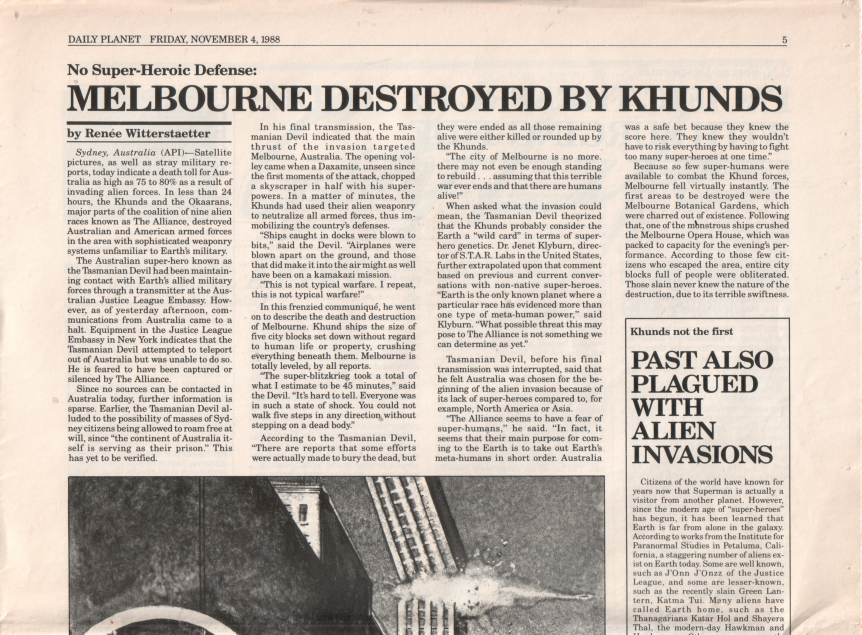
Page 5 held two more stories, one from Sydney (that includes news of the death of the Tasmanian Devil) and one from Washington (that reports the death of Arani Caulder of [one of the versions of] the Doom Patrol. It also contains a sidebar on previous alien invasions that highlights a number of JLA stories (and contains a reference to V as well).


Page 6 had two more stories, from the Pacific and Cape Canaveral, and another sidebar on bombings.

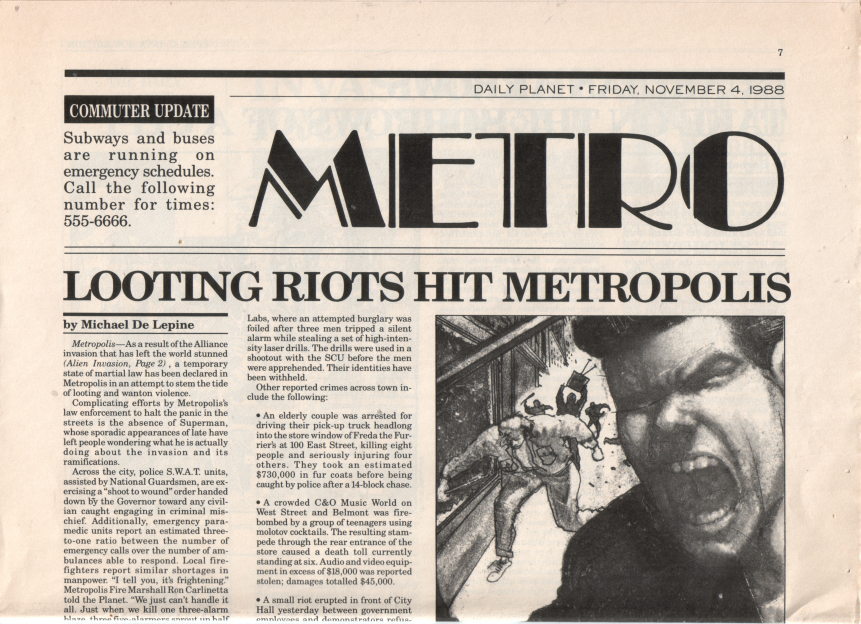
The Metro section started on page 7, and included subway and bus conditions as well as local stories on local disruption caused by the invasion. It includes a picture of Metropolis Mayor Berkowitz and accounts of philanthropic response from Lex Luthor to the situation.


Two Metropolis stories filled page 8, along with one story from Washington on pending paranormal legislation.

The Planet's masthead is on page 9, along with an editorial from Perry White (yay, Perry - one of my all-time favorite characters) and "Metro Report," a column by Clark Kent (didn't Byrne make Clark a columnist rather than a reporter?). This page also contains the inquiring photographer feature.

Page 10 is the Business section, and has stories on the stock market and Lexcorp, as well as charts of the NYSE and gold prices.

"City Life" is on page 11, with a film review from Cat Grant, an advice column, and Teen Beam by Sidney Mellon (does anyone else remember that enfant terible persona?).

Page 12 has the TV listings and movie ads, while page 13 has the crossword puzzle and comic strips.

Cat Grant returns on page 14 with a gossip column, featured alongside the horoscope and the soap opera round-up.

Sports coverage fills page 15 and the last page.

Throughout all this content, the piece manages to maintain the illusion of being a real newspaper while at the same time giving a nod and a wink to a lot of DC history and personalities.

All the minutiae of a newspaper is here: consistent headline fonts and by-line borders; appropriate formatting and positioning of stories; ad placement. The text of the news articles is a little more contemplative and less breathless than would be expected in a newspaper extra, but the voice in the features rigs true. The newspaper photos are either real photos or drawings by the likes of Kyle Baker, Eric Peterson, and Dennis Janke, done in greyscale and in a non-comixy style. Willing suspension of disbelief is pretty easy.

Of course, DC staff had a field day with jokes. While the invasion-related stories are serious enough, much of the issue is filled with sly references to the DCU. More on those in the next installment.

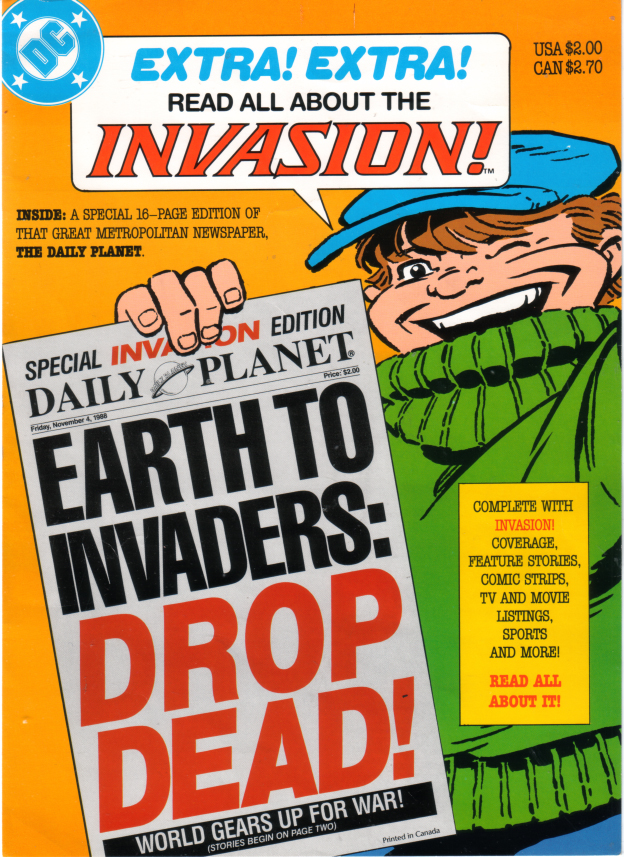
In the meantime, here's the liner/cover of this special edition: the cardstock insert that was in the plastic bag with the paper. This is what you would have seen on the racks. What's the name of this member of the Newsboy Legion again?


Friday, January 13, 2006

A crossover of sorts

I guess I would have to put myself firmly in the DC camp, at least if we were going to buy into the whole "there's two kinds of people in the world - DC fans and Marvel fans" thing.

Of course, at my comic-buying peak (1971 to 1980 or so), I bought everything that came out from the Big Two (which were, for all practical purposes, the only two most of the time). Well, maybe not everything: I got all the superheroes (solos, groups, and team-ups); all the war books (the great DC ones and the crappy Marvel ones); all the westerns (even the reprint titles), and all the one-offs like Kirby's In the Days of the Mob. I didn't buy Archies or funny animals or romance, and stayed away from the more expensive stuff, like the Warren magazines that were starting to come out, but I would walk to the Bay Ridge Stationery every Tuesday and come home with ten or more funnybooks. At the same time, I was backfilling some series, and getting close to having complete runs of titles such as JLA and Daredevil. I was sketching as many (or more) shots of Spider-man in my school notebooks as I was the Atom.

But in sensibility, I was always a DC man. A lot of my friends talked about how Marvel was "more realistic" or "more mature" or "more sophisticated" or more-something-or-other; I guess I never saw it, at least enough to let it make a difference to me.

That's all a prelude to the next item in The Shortbox, a two-issue story that is technically a Marvel adventure, but which is DC in more ways than one.


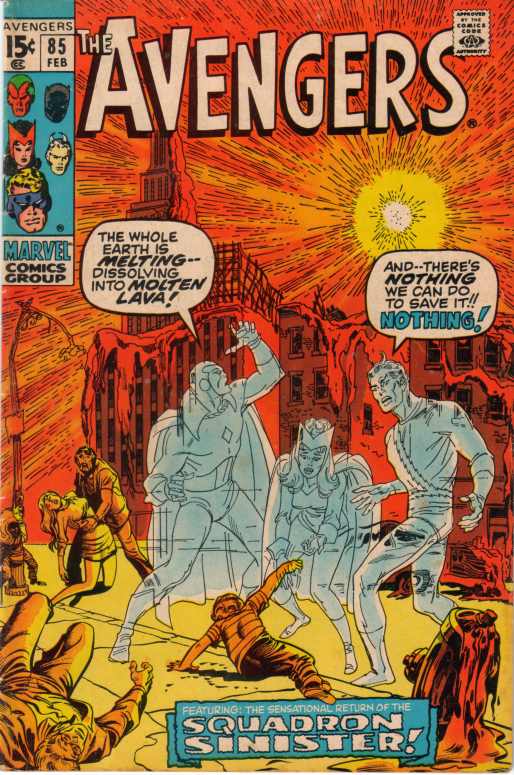
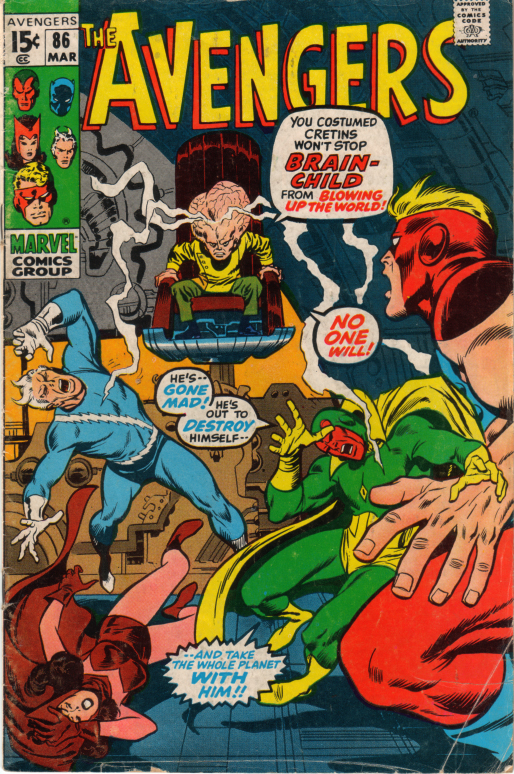
The Avengers 85 & 86, 1970-71
Roy Thomas, Writer
John Buscema & Sal Buscema, Artists (respectively)

Before we even get inside the books, look at those covers -- plastered with word balloons and/or blurbs, portraying (or approximating) a scene from the story, showing characters who are describing the action that is taking place to no one in particular -- and tell me how they are more anything than any standard Silver Age cover. Looking at issue 86, I can squint and turn the ghostly heroes into Batman, Wonder Woman, and the Flash without half-trying, and it looks fine.

The blurb on that issue is the key to the significance of this story, although technically it is not the Squadron Sinister that returns, but the Squadron Supreme that debuts. But that distinction hardly matters, since the Squadron is the Justice League anyway.

See, about a year or so earlier, Roy Thomas had written some JLA-analogues into an Avengers story as villains: The Squadron Sinister. It was apparently intended as a one-time homage.

These issues were both a reprise of that idea and the development of a mutual homage, since some Avengers-analogues appeared in JLA the same month as this story began. In-story, the new faux-JLAers in The Avengers were not the same folks as the earlier ones, were heroes (The Squadron Supreme) instead of villains, and included more members than the original four.

In fact, all three groups went on to have more-or-less extensive careers and the usual tangled continuities; you can read all about that elsewhere on the net, maybe starting here, and it's worth the time. I just thought it would be fun to take a look at an early, less complicated version.

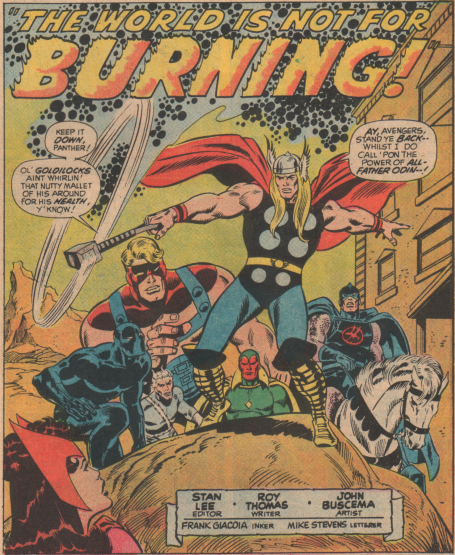
First of all, this is the Avengers line-up were dealing with:


The Avengers line-up is like the cast of Saturday Night Live: there are good times and bad times. I think this bunch is pretty solid, although I am no Avengers historian. I remember liking this version of the Black Knight, thinking that Clint Barton was an even bigger jerk as Goliath than he was as Hawkeye, getting frequently bored with Wanda and Pietro, and, of course, loving the John Buscema art no matter what. (I also think that John drew some of the best Superman art going, and wish he had done more.)

These Avengers, a few seconds from a tussle in another dimension, are teleporting home, except that four of them (Vision, Scarlet Witch, Quicksilver, and Goliath) wind up on an Earth-One analogue. After some unexplained glimpse of a future global disaster, they run into the Squadron Supreme at their headquarters (unclear antecedent intentional) and, of course, fight them. Here's the roll call of the JLA, er, the SS:


Nighthawk is a pretty good Batman stand-in. He's not much like the hardcase, master strategist we know today, but more like the adventurous detective of the time.


Tom Thumb is not a whole lot like the Atom, except that he's little (I'd guess about two feet tall). He doesn't change size, but has lots of gadgets.


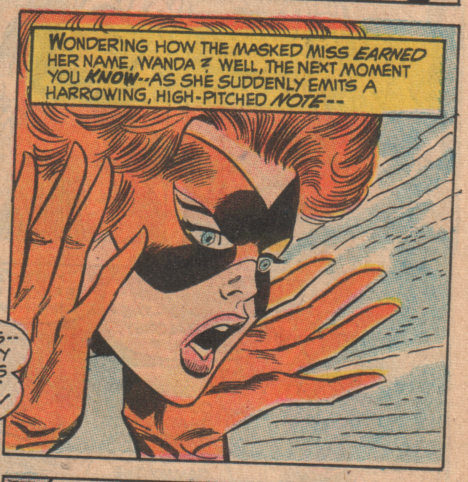
Lady Lark might be a little too close to that era's version of Black Canary, even for homage.


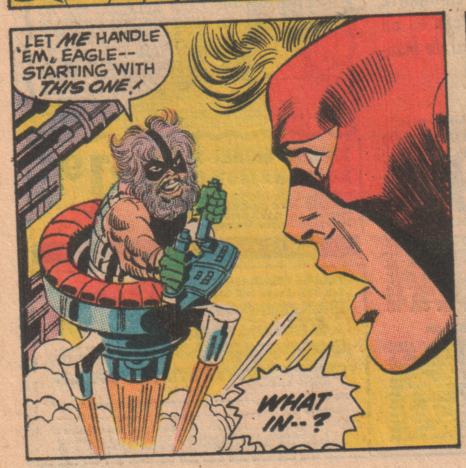
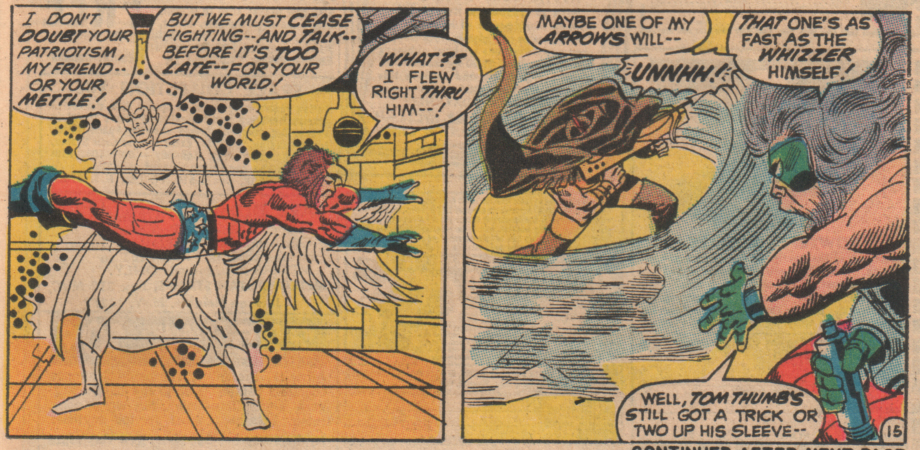
American Eagle is Hawkman, with a layer of Captain America on top and streusel swirl of stupidity. (Later versions changed the name and concept to be more like Hawkman, or at least less annoying; I believe the new character is revealed to be the Eagle's son.) Hawkeye (couldn't they think of a different archery-related name?) filled the Green Arrow slot. I have found that all archery-gimmick characters are about the same, and this Hawkeye is not distinctive (except for dropping some, but not all, of his aitches in what I think is an English accent.)

After clearing up the misunderstandings (well, with Nighthawk, anyway - they leave the others unconscious; I guess it just seemed easier), Nighthawk and the Avengers head off to Cosmopolis (how cool -- a mock-DCU place name!) to find the other SS members in order to stop them from launching a rocket that will (unbeknownst to them) trigger the end of the world. Of course, the Avengers have to fight them first.


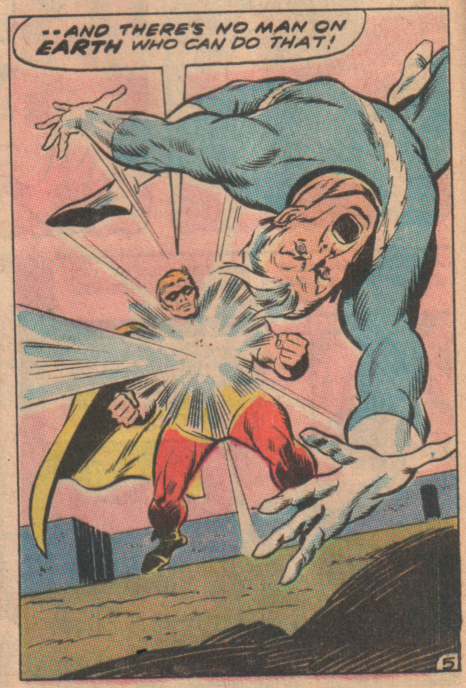
Hyperion is the SS Superman, although he seems more just "the big muscle" rather than "the Big Red H," if you know what I mean.


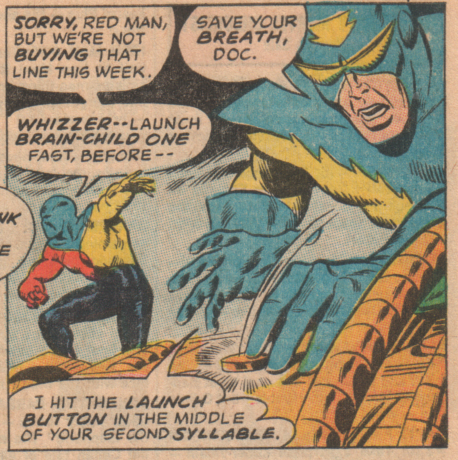
Doctor Spectrum is the Green Lantern counterpart. He appears to be the leader and seems a lot smarter than Hal Jordan; maybe that's because he doesn't get hit in the head once in the entire story. Whizzer (another recycled name) is the Flash, with a pretty goofy costume, except for the goggles, which I always thought were a nice touch.

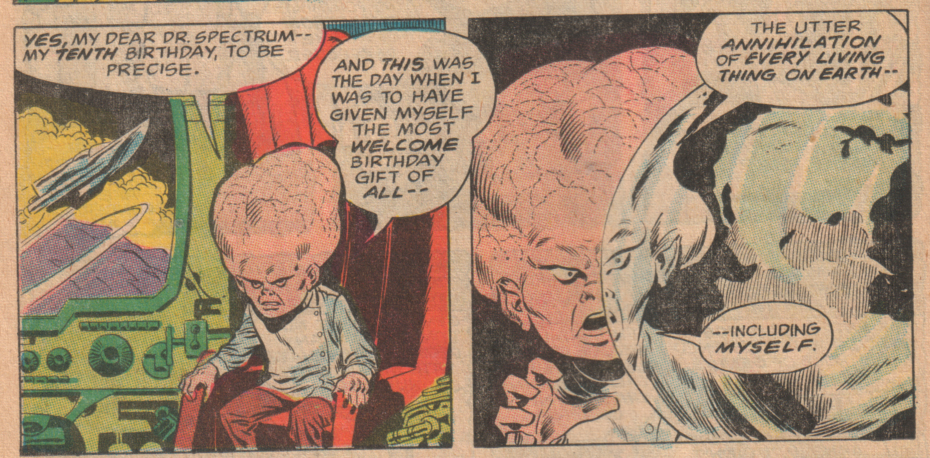
These three and Nighthawk form the "classic" Squadron Supreme (i.e., the same characters as the Squadron Sinister) and it is with these four that our four Avengers team up to face the villain of the piece (who was behind that deadly-rocket business), a ten-year old boy:


Just your standard-issue super-genius, social-misfit, tool-of-the-government, exposed-to-radiation-at-birth, prepubescent evil mastermind.

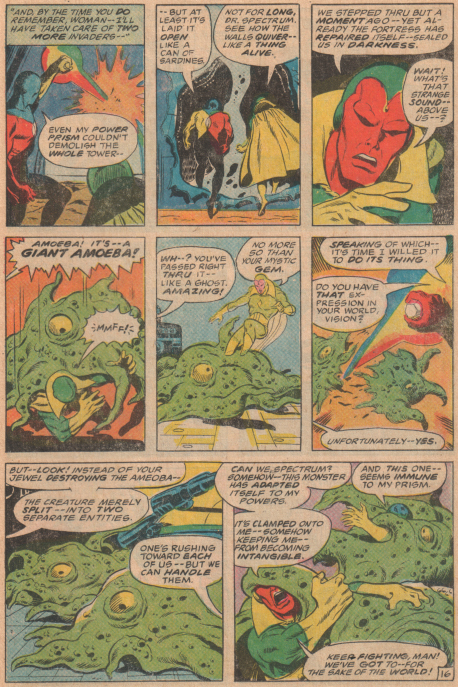
In a clear nod to typical JSA and JLA plot arcs (not to mention the original "crisis" crossovers), the heroes confront Brain-Child (yeah, that's his name) on his island fortress (to stop his back-up plan for destroying the Earth) by breaking up into four pairs (matching up heroes from each group) and advancing against separate threats. In one episode from this struggle, we get a veritable catalogue of Silver-Age goodness, as well as proof that DC heroes are better than the Marvel heroes, even when they are DC-like:


Ongoing exposition: Don't just show the action - explain it as well!

Green Lantern butt-shot: Well, it's actually Doc Spectrum's butt, and it's not very good shot, but I'm counting it.

A giant amoeba: How silver can you get?

Bonus giant amoeba goofiness: Doesn't the nucleus seem like an eye, watching the heroes at all times?

Poorly-used or self-conscious slang: Watch the Power Prism do its thing!

Irony: Don't blast an amoeba in two, you dopes! Especially super-adaptable ones.

Proof DC heroes (even Hal Jordan) are smarter than Marvel heroes: Look at that last panel. In the same circumstances, Green Lantern would have zapped J'onn J'onzz's amoeba into a big wastebasket or something, and J'onn would have blown GL's amoeba away with Martian breath, and they would have shared a homely moment about teamwork. These guys just stay smooshed for the rest of the fight.

So, the combined groups eventually reach victory only when a battered Goliath uses an unconscious Hyperion as an arrow in a makeshift giant bow to shoot Brain-Child's control pod. I'm kidding. No, I'm not kidding.


After de-geniusifying the kid, the Avengers are somehow dragged back home by a combination of Mjolnir's power and Stark technology. The story ends with the Vision wondering if they are back on their own Earth or perhaps on yet a third Earth. Shades of a Crisis that was still over two decades away! Or Sliders, even. (That musing must have been the more-sophisticated part.)

Looking back on the story now, I don't think it has aged particularly well. While the art is splendid and the action is fun, I have skimmed over much of Thomas's purple prose and heavy-handed literary allusions as well as several big plot holes with thin patches over them. But when this comic came out, the Superman/Spider-man crossover special was still about five years off; seeing a JLA/Avengers crossover, or any DC/Marvel crossover, even in a disguised form, was really quite a treat, especially for a sometime switch-hitter like myself.

Additional notes:

In 38 pages, this story has one splash page, 31 six- or nine-panel grids (or close), and six other page layouts.

Remember way back there at the beginning of this post, when I talked about backfilling my collection? That was when dinosaurs ruled the Earth and there weren't many comic shops. My buddies and I would take the bus from the Port Authority Terminal in Manhattan (I lived in Brooklyn) out to this store, whose ad was in these issues:


I got their catalog in the mail, a ditto-copy of a manually-typed list; the 'e' was blurry, so it always looked like Groon Lantorn. We'd bus out, pick up an armload of back issues, grab a grilled cheese at the Woolworth's, and read most of 'em on the bus and subway rides home.

Geez, I sound like Wilford Brimley.